 Image by Tommy Ironic via Flickr
Very informative. I think at the end of the day it's similar to what happened 100 plus years ago. You had guys with mines, or oil wells, or whatnot, and they had the valuable item, so they got to decide who they allowed to work there and how much they got paid. And it comes down to this: do I pay my lowest paid 10,000 workers $15 an hour, or do I pay them $7 an hour and make an extra $80,000 dollars per hour. That comes out to 166.4 million dollars per year that the guy can either keep for himself, or pay the working man.
 Image by eamoncurry123 via Flickr
Except now it's not a guy, it's a small group of guys, with a whole ton of shareholders watching their every move, and both the leaders and the shareholders want the money, and either they get it or the working man gets it, and it's the decision of the people with the power and the money. Except it's not a decision. They decision has been made. Over and over again. All the extra money to those with the power and the money.
 Image via Wikipedia
And the people with the power and the money are saying 'give us the tax breaks, and the power, and the money, and we'll make more power and money, and this will grow the economy, and then we'll all have more power and money. But somehow only the people with the power and money end up with more power and money.
And the people with the power and the money say 'of course I help the poor. I have large houses built, and I consume many goods, and I visit the world all over, and these things provide work for others, so they can get power and money. But the people that get the power and the money are not the people that build the houses or the cashiers that they pay for their prodigious consumption or those that fly them around in luxury, but those that own the companies, who are themselves other people with the power and the money.
 Image by lipjin via Flickr
And the people with the power and the money say 'I invest my money in new and smart businesses, which grow and provide more work for the working man. In this way I give back to those less fortunate, and act for the greater good of all. But the riches earned by these investments return again to the hands of those with the power and the money, and the working man is helped only with one more option of work.
 Image via Wikipedia
And the people with the power and the money say 'I have done well because of my good choices' and ignore that their choices where much less important than their social network and the opportunities that were given them by others. And they ignore that they did not work harder, or help others more, or do anything of merit to obtain so much more than their fellow man.
 Image by epSos.de via Flickr
And the people with the power and the money say 'You give a man a fish, but we should teach the man to fish, and he will never go hungry again,' but they neither give fish or teach to fish. And they say that competition for resources is a natural state for man, and 'It's not my fault that I am better at it than you are.'
And the people with the power and the money say that giving money and power to the working man is wasteful, as they will squander it on such poor investments as food, clothing and shelter.
 Image by Shreyans Bhansali via Flickr
All of these things are said by the people with the power and the money. The rest of us are too busy working to say anything. ;)


 Others, like myself, may live in poverty, making far less than the established guidelines for poverty, and yet, we consider ourselves middle class. The idea of class originates in Europe from what I know, and was used in a time when class positions were not easily changed. Here and now many of us may make minimum wage when we are teenagers or even in the twenties, and make more than $100,000 per year later in life. Of course class wasn’t and isn’t just about income. It’s about culture. And in any case I hate class. The idea of some people being better than others because of the way they were raised. It continues to exist to some degree here, but thankfully, I believe it is much less prominent than in previous times or in other places. In any case it is all relative.
 An Alexander the Great or a Julius Caesar did not have the internet. He did not have air conditioning. He did not have his choice from hundreds of different food items at any given time. He did not have a car. He didn’t have living quarters free from bugs. He didn’t have over the counter pain killers. While he may have had tailor made clothing, there weren’t a wealth of materials to choose from. He didn’t have TV or movies or video games. These are differences between him and us, and it is us in the enviable position of being the “haves”. Not only are these differences between peoples in ancient times and us, they are differences between us and others that are living and breathing right now. There are people that don’t have any of these things, and there are probably hundreds of millions of them. I just put $10,000 into the annual income cell at http://globalrichlist.com/ If I’d made that amount last year then I would be richer than 86.69% of people on planet earth. The reason that this is the case is that money is not evenly distributed… AT ALL!!! Look at the income graph below:
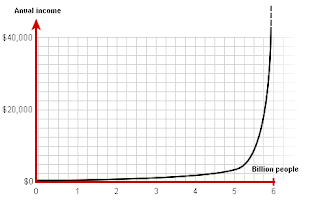 Graph from: http://benbyerly.wordpress.com/2008/11/28/how-rich-are-you/
 When I was in my second year of college, after my mission to Colombia, I had a friend that was single and raking in the money, and he didn’t know what else to spend it on. I was taking a personal finance class at Utah Valley State College (now Utah Valley University) and showed him the magic of compound interest. When he moved out, he had been getting interest on $1,000 per month invested for a number of months. If he does that for 40 years at 7% interest, he’s up to 2.6 million dollars. I should have charged him for my services.